Pre-Canceling Myself: Part 1
Setting Context, Explaining and Rationalizing

“What do you think about the current…culture?” a friend of mine asked me a few years ago.
As I tried to get specifics, it became clear he was alluding to the infamous…“Cancel Culture.”
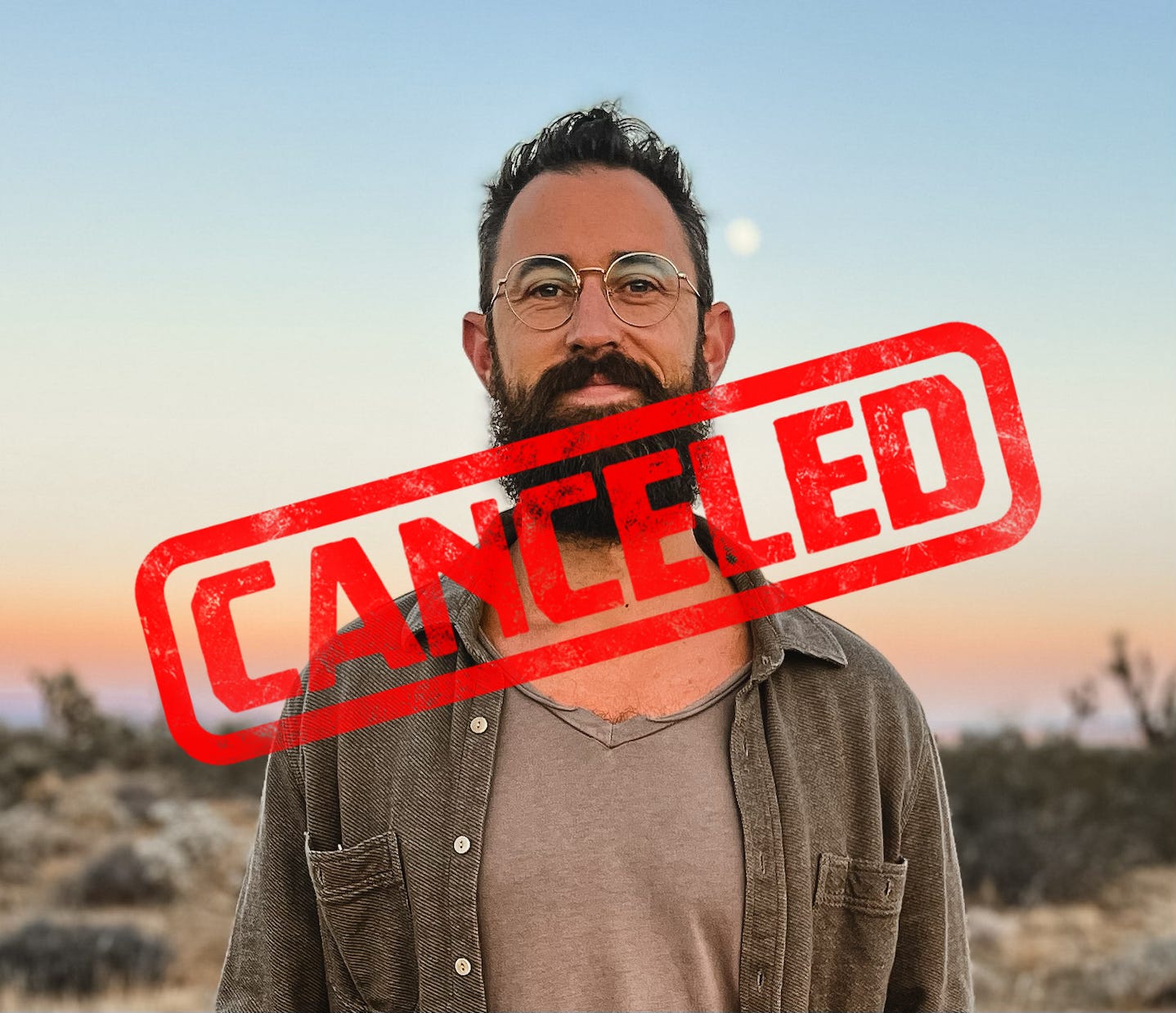
I broach this subject with about as much hesitation as I can sustain without it continuing to prevent me from stepping forth into the swamp. My desire to move toward the subject in spite of the polarizing melee the term engenders is a testament to the pain it causes me to continue along the path of self-censorship.
Without premeditation, I responded to my friend with an answer that was so accurate to my point of view, I surprised even myself with my eloquence. I KNOW. (If this joke isn’t reading via text, this is me playfully feigning shock, assuming you hold me as both adept with the English language, as well as someone who is quite self-impressed.)
I said something to the effect of, “I view the current climate around expression similar to the way we surgically remove cancerous growth.
In this case, our metaphorical “malignant tumor” is the words and actions that are causing suffering. As with the case of surgery, we don’t just remove the tumor, but we also remove some of the healthy tissue around it to make sure we got it all, just to be safe.”
In the world of medicine, most of us probably agree this is a good call. This consensus dissipates when it comes to expression.
The adage “Better safe than sorry!” tends to reflect the current cultural approach of those self-identifying as liberal, who are more comfortable losing some potentially “benign” expression so as to ensure we’re removing that which is “malignant.” Those self-identifying as conservative are currently more likely to view this etiquette as infringing on our right to free speech and not worth the net cost.
Core to this issue are two main threads: a fundamental disagreement about what is deemed malignant, and the degree to which it is ethical to control the words and actions of our fellow humans.
It is here that strong advocates of free speech often point to a quote misattributed to Voltaire, “I disapprove of what you say, but I will defend to the death your right to say it.”
Before moving fully into the ethical dilemma this conundrum asks us to face, I want to reveal where I currently stand.
I have historically related to this cultural shift as a necessary swing of the pendulum, a correction of sorts. Just as we individually become more aware, learn, grow and evolve, we as a society are doing the same. With new awareness comes greater responsibility.
And I have questioned aspects of the execution, as well as the ethos, of the unofficial, decentralized “Cancel Culture” approach itself.
It is at this point that I imagine you may be starting to suspect that I am going to announce I am joining Elon Musk's “Free Speech” chorus. I’ll ask you to hold off on coming to any conclusions and stay with me in the mucky, uncomfortable gray area. (Just to be clear, I’m not.)
CONFESSION AS PSYCHOSOCIAL TECHNOLOGY
I am far from the first person to pen a public confession. Rousseau did it. Tolstoy did it. Even Usher did it.
Countless others have fessed up over the course of human history, but a confession is usually only offered because one “has to,” be it under oath or by threat. We don’t like being honest about our depraved, disgraceful and dastardly deeds. In my case, I’m opting for the ever perplexing, voluntary “unforced error.”
(Of course, the degree to which it is voluntary is questionable as the gravitational pull of doing so feels irresistible at this point. From here we may be tempted to move into the fate vs. free will debate, which we will not solve with language, so we’ll set it aside for now.)
I’ve come to appreciate confession as a psychosocial mechanism. I can see why, from a strictly practical standpoint, the Catholic Church installed this practice. It allows the members of a community the opportunity to unburden themselves of a great mental weight, which may have prevented them from being functional and contributing to the common good. (Are there more cynical or sinister frames for viewing this practice? Of course, but let’s suspend our judgments just for the moment.)
To attempt to ritualize forgiveness in such a manner that doesn’t require massive social upheaval or cost an individual their social standing is quite a workaround. For those choices, inclinations or dispositions that we find utterly unacceptable in our souls and simply cannot access self-forgiveness, we can turn to God’s mediator who invites us into a grace beyond our current capacity.
With this method we run into the potential for hypocrisies and double standards when we get into law and justice. Where do we draw the line for what is forgivable and what is not? To what degree, and for what acts, is retribution a requirement for repair? We may have various feelings about these crucial social issues, but as a spiritual process I like some of the upside.
However, given the results over the course of centuries, I question the practice of one man holding the secrets of an entire congregation. A great number of priests seem to succumb to their own demons. It’s possible that walking around with the awareness of all the hypocrisies and misdeeds in their parish has its own impact. The pressure seems to be *ahem* getting to them.
This social bypass also denies a community the opportunity to collectively process and work through whatever breaches of communal agreements have occurred. Just because people aren’t aware of something doesn’t mean they aren’t feeling the impact of it, even unconsciously.
All of this said, I appreciate that a confession affords us the opportunity to come back into alignment with truth, to return to integrity and restore trust.
And that seems to be the strongest piece inspiring this movement in me. To continue participating in social norms while internally being aware of my hypocrisy simply isn’t tenable.
The logic goes something like this: the degree to which I hide my mistakes, politically incorrect opinions and self-centered acts from others is equal to the degree to which I am actively lying to you. How can I possibly be in integrity while withholding my lapses in moral judgment and ethical transgressions?
(“But what about privacy?!?” the ego screams in a desperate attempt to protect itself.)
Meanwhile much of digital culture runs on an endless barrage of proclamations of moral superiority. Be that by way of virtue signaling, broadcasting our good deeds and accomplishments or simply (and more commonly) damning the misdeeds of others.
While the internet clamors for moral high ground 248 characters at a time across social media platforms in various states of decay, using devices built with minerals dangerously obtained by “child labourers” in the Congo, constructed by “child labourers” in China, I’m sitting here “SMDH.”
One could say this is my own odd form of claiming moral superiority. Though I’m not proclaiming my sterling record of principled behavior, I am doing the opposite. But I cannot shake the sense that the willingness to disclose one's indiscretions and negligence is, in fact, a form of relative moral superiority. Perhaps only undermined by the awareness of such.
In light of all this, I find myself repeatedly retreating to something I tweeted years ago:

WHY AM I DOING THIS?
I’m putting my money where my mouth is. I’m inviting all the skeletons out of my closet and getting it over with. Timeline hopping into the version of my life where I’m actually living my values.
I want to believe that “the truth shall set you free” works at scale, but I can only find out if I actually leap. While I’ve become aware of the little ways this has played out via many forms of deceit in my personal relationships and the suffering it has caused, I keep imagining a life in which I am no longer burdened by the fear of “the truth coming out.”
A friend of mine went through a divorce, and though it was never confirmed, the story was that they had cheated on their partner. When talking about it afterwards, they said it was oddly liberating to be seen as the person “in the wrong.” Not that it gave them a moral pass, but the need to attempt to keep up a sparkling image became futile, so there was a forced letting go of that social strategy.
To be clear, I’m not proud of anything I’m about to reveal. In fact, it is just the opposite. I feel a significant amount of shame, regret and disappointment looking back at these actions. And, I don’t know of an alternative which allows one to avoid making mistakes in the process of learning and growing.
I must also acknowledge that the list is incomplete. Think of it as a sampler platter representing that which I find disgraceful in myself.
NO, BUT SERIOUSLY, WHY WOULD I DO SUCH A THING?
In a world where we’re all repeatedly (explicitly and implicitly) asked to be socially acceptable, I am voting by way of my current actions for a culture that acknowledges mistakes. For a public discourse that values nuance. For a collective that is willing to be with complexity, and instead of defaulting to cathartic reactions, seeks instead to understand so that we might actually learn and grow together.
If my acceptance into society is reliant upon having never made a mistake, well then, I’m out. I’ve done and said so many things I regret. I don’t stand by half of what has left my mouth over the years.
While I like to think I’ve been fairly skillful with my language. I’ve gossiped and shit-talked and said all kinds of things out of fear, anger, spite and a desire to belong. Looking back, I often judge it as pathetic. But I also have some forgiveness for myself. I was learning. I was navigating different social environments. I was trying to make money. I was trying to be liked. I was trying not to be associated with those who were on the outs.
With the technological entanglement we now navigate, some form of our human development is on record. This only exacerbates this issue. Photos of me drunk in college are readily available for your viewing pleasure. I can’t imagine what it would have been like to have social media in high school
My intention is to acknowledge my shortcomings and wrongdoings. To honor my commitment to the truth by sharing the pieces that most frighten me. If my commitment to the truth is limited by my desire to only be perceived in a positive light, then it is no commitment at all.
I’m going to let you know about the pieces I don’t want you to know about so that you may hold a more complete idea of me in your mind. And by doing so, I imagine more freedom opening up in my world. I can let go of my futile attempts to hide my shadows. I no longer must pretend that I have an untarnished reputation. And by extension, the same applies to you.
(I’ve listened to the song “Cancel Me” by Dominic Fike countless times hoping to summon the courage to just do it myself and experience a bit of the freedom he imagines in his lyrics.)
To be in integrity now, is to acknowledge that my integrity is a work in progress. It’s humbling to acknowledge it, but it is true. When my aversion or craving is particularly strong, I’m more apt to lose track of my values. And for us to function with some semblance of ease, we’re going to have to make room for this fact.
Perhaps you’ll decide I’m no longer someone you want to associate with, or that I don’t deserve respect. I honor your choices. But at least this way I can relax knowing that if you are in contact with me, you are in contact with a more comprehensive sense of me. The good and the bad. For better or worse.
But my intentions aren’t purely altruistic or selfless.
There is also something in here akin to the “Stealing Thunder” psychological strategy Eminem’s character in “8 Mile” uses in his final rap battle. All potential blows are outed before they can be used against him. Self-awareness and disclosure as a preventative defensive maneuver.
I’m also kind of excited. I’m self-canceling as some form of psychological and social extreme sport. It’s almost like the way I’d respond to a dare in high school. I wanted to be seen as the guy who would do the thing you’re too scared to do, which would in turn often earn me some kind of social status. Only in this case I dared myself, so maybe I’m just attempting to gain my own respect.
To further out myself, I also must acknowledge that in my reveal, my desire for status and power still exists. It sounds crazy as I write it, but I have a working hypothesis that to reveal in this way will likely garner me some level of acclaim or admiration. I’m being provocative as a way of getting your attention and I’m following up on that with receipts on myself to fulfill my “brand promise” of being as honest as I know how/feel safe to be.
Isn’t that twisted?
Worse still, this article itself is a bit disingenuous as I don’t actually find anything I’ve done to be sufficiently cancelable. Unsavory? Yes. Unflattering? Certainly. But…unforgivable? No.
If that were the case, I probably wouldn’t have the audacity to be writing about it and sharing it on the internet.
More accurately, I imagine most of us have done and said things we’re not proud of that could get us canceled. We’re all cancelable in some way, and that undermines the entire movement. As the comedian Tim Dillon once said, “the problem with the woke boat is that eventually everyone gets thrown overboard.”
Quite possibly worst of all is that I both resent living in a culture that feels so incoherent and simultaneously relish that I have the opportunity to speak as a “more coherent” voice. I both don’t want to have to step up and stand in this, and I also very much want credit for being willing to do so. As I’ve waited to publish this article I’ve even lived in fear that someone would “beat me to it,‘ and I’d miss the chance to get the kudos for being so brave, vulnerable and honest.
For whatever reason, I’ve told myself that before I embark on other creative endeavors, I had to say all of this first. That in order to have a chance at being in integrity moving forward, this piece had to be shared. Maybe I’m just trying to get right with God.
While I haven’t figured out how to be free of my shadow, I am at least now more willing to say something if I see something.
WHAT’S IT LIKE TO BE READING THIS?
I wonder what it’s like to read these words. Do your own disowned actions come to mind? Are you immediately aware of the pieces of yourself you don’t want anyone to find out about? The ones that you think for sure will get you kicked out of your community, friend group or family?
Does the subject matter make you nervous? Are you afraid that if you “like” this post, someone might see this and think that YOU are a free-speech advocate? I ask because I know this place in myself. For example, one day I noticed I was afraid of liking the post of a comedian who was still working with Louis C.K. “This joke is funny, but will people think I should stop supporting this person because they haven’t cut off communication with a sexual predator?”
Do these questions alone make you want to stop reading? Afraid to get too close to a nuance that could change your self-identity and relationships?
I imagine some of this is true for some of you. Maybe others feel exhilarated. Excited by the prospect of deeper reveals. I suppose I mostly hope you experience some kind of vicarious relief that inspires you to bring a little more of yourself into your own world…which just happens to be our world.
Much gratitude is due to the friends I’ve dug into this material with via open dialogue over the years, examining what I view to be a universal human experience that we each encounter in our own subjective ways. I’ve been particularly inspired by people like Africa Brooke, Clementine Morgan, Brene Brown and a great many people of TPOT who are publicly championing the values I am growing the courage to stand in.
WHY CONFESS NOW?
I would have loved to have done so earlier, but I was too scared. I started writing this article in April of 2021. I’ve spent the past four years fearfully holding a gun to the head of my social identity, in some strange form of holding myself hostage. Trembling as I waited for “the right moment” to put it out of its misery. Better late than never?
I’ve spent days upon days thinking about this topic, writing pieces in my head, sketching half-ideas out in my notes app, and typing in google docs until I get stuck in self-doubt and fear and resort to opening an incognito tab and jerking off to release the tension.
Between living in what is being referred to as “a post-truth world” and the proliferation of AI, I feel profoundly concerned by the lack of transparency, coherence and ownership from most corners of society. (Is this just a projection? Quite possibly.)
Scrolling online, I’m constantly assessing the degree to which I can trust what’s being shared. There is a sense of struggling to find solid footing. And with the amount of content I’m consuming, I simply can’t fact check every story or idea that hits my feed.
As I said to a friend recently, “the absence of truth is essentially a hell realm.” Being online in particular can be like navigating the disorientation of a carnival funhouse mixed with the panic of being pulled by the undertow of a wave and not knowing which way is up.
Meanwhile, authenticity is a very hot buzzword. It appears to be in the mission statement of every company, organization and influencer.
I feel moved to (lovingly) call bullshit on the prevalent feel-good spirituality version of authenticity being peddled online and in many social circles. But the only way to do that, is to show up in a deeper cut of authenticity.
I’m tired of truthful conversations being relegated to side convos and slack DM’s. I’m tired of being gaslit and I’m tired of pretending that I believe people when I perceive an absence of truth. I’m tired of suppressing my own calls to action to avoid rocking the boat.
The dam I have built in my psyche to suppress that which may be impolite, uncivil or inappropriate appears to be on the verge of breaking and this is my version of a controlled persona demolition.
WHAT IS CANCEL CULTURE IN 2025?
Admittedly, the context around this term has shifted quite a bit in the past four years. It is much less provocative to do something like this now than it was when the idea first struck me. Were I less of a foolish coward, maybe I would have acted on that first impulse. Alas, I’ve waited until I had enough courage/trusted myself enough/felt safe enough to do so.
Some people don’t believe Cancel Culture is a thing. Some people think it IS a thing and it’s good. Others think it’s a thing and it’s BAD. And some think it’s a thing, and it’s good, but it doesn’t work. (For example, Shane Gillis was “canceled” and is now way more famous than he would have been toiling away his first few seasons at SNL. He’s hosted the show twice!)
Regardless of where one falls on the spectrum, I invite us to look beyond the clickbaity phrase to the individual and societal motivations that are driving this phenomenon.
Attempting to describe this relatively objectively, Cancel Culture appears to be a pattern in which people, mostly using the internet, collectively retract their support or publicly denounce (and sometimes shame) a person, product, service or company.
Looking at this positively, I believe there is an earnest movement to “build back better.” (rip lol) To use language more skillfully. To do no (or less) harm. To hold power in check. To hold each other accountable.
There is also the potential shadow side of this social phenomenon. It seems to me that at least as often as legitimate accountability motivates the calling out of unskillful or harmful words and actions, there is a darker motivation to gain status by tearing another down.
People can build their entire online brands (read: social acceptance and livelihoods) condemning the behaviors and actions of others. Angry, righteous tweets are rewarded in the algorithm with likes and engagement. It seems to satisfy some carnal blood thirst in us, be that a desire for vengeance, cruelty or scapegoating. And our public denouncements of immoral behavior ensure that we’re seen standing on the right side of history. (e.g. The Red Scare, Scarlet Letter, Salem Witch Trials etc.) In a fascinating turn, this approach seems to be happening in different forms on both sides of the political aisle.
One challenge is that we’re an evolving species and our social body is comprised of wildly different and shifting worldviews. That which was acceptable 20 years ago is not now. The line is always moving.
And our personal sensitivities are deeply shaped by our worldviews. If you are a follower of Christ, you may feel offended by jokes referencing Jesus, God or Christianity. But if you’re an atheist or agnostic, those same jokes may be just plain funny.
It is my hope that we can extend some grace to our individual and collective missteps of the past (as well as the likelihood that we’re doing the same right now) and also bring some awareness to the fact that we don’t all have the same worldview.
I am not the first person to weigh in on this topic, nor do I think I am unique in my opinion. This expression is my own attempt to keep breaking out of my patterns of omitting and hiding the parts of myself that I fear make me ineligible of being a respected member of society. In fact the stakes are much higher than that. This self-censorship seems to be an extension of the survival instinct. A deep, cellular level fear of becoming a social pariah.
And of course, I sit knowing I am already guilty. I am a sinner. Oh, the ironic twist of rejecting Christianity for so long and coming to see the ways in which some of its core tenets feel right on the mark.
I just had to live long enough to experience enough of my faults and failures to relinquish my self-concept and witness the ways in which my own thoughts, actions and behavior do not always fit the idea of myself as “the good guy.”
But also, it seems to be a reflection of my willingness to take a step back from the conditioned framing around behaviors that make one “good” versus “bad.” If we acknowledge that one's values and behaviors may differ quite a bit depending on one's worldview, then we also must admit that the data used to decide what makes one cancelable is subjective.
To be clear, I am in no way excusing the behavior of those who have committed violent crimes. I also ultimately appreciate that social media has provided an outlet for those usually oppressed by power to have their voices heard. Please do not mistake my words as any kind of condemnation of accountability. There are consequences for our actions, and we ought to be with the impact of our actions. In fact, it is my sense that the willingness to be with the impact of our actions is potentially the optimal way to bring about natural change or growth.
CLOSING
“How do you know that you are on your path? Because it disappears.” - David Whyte
I wish I could confidently say that I agree with Mr. Whyte, the truth is I have no idea.
I don’t really know what will happen after this. I am worried that when invited to be aware of your own skeletons and attempts to keep them in the closet you will deny and reject me, clinging to the familiar comforts of your constructed world as I have to this point. And quite frankly, I wouldn’t blame you.
But I suppose more of me is placing my faith in the quote from Anais Nïn: “Life expands or contracts in proportion to one’s courage.”
So do with this information as you will. It is my frank hope that by bringing more of myself into the collective, there is more room for each of us to show up fully. Not just fully in the idealized versions of ourselves, but full in what I think people mean when they talk about our humanity. Faults, flaws, frailty and all.
…With that out of the way, in my next article I will finally pre-cancel myself.
What would politics and culture look like if we all named our missteps publicly, and were not ostracized for doing so? It’s a curious question!
I’m still here too. Ride or die. One of the best things I’ve consumed on the subject of about cancellation is this, by Jonathan Rauch: “The Cancel Culture Checklist”. If two or three of these things are happening to you, you’re probably being cancelled. And if a third party is cheering these things on, they are not simply “criticizing”. They are aiding and abetting a cancellation. Which is not cool. https://www.persuasion.community/p/the-cancel-culture-checklist-c63